Tuesday, August 20, 1985

My Honda CX500

One afternoon, while my ship the USS America was in port, I was sitting around lamenting a lack of fun when my friend Paul mentioned he'd run into some cash problems and wanted to sell his Honda CX500 motorcycle.

This got me reminiscing about the fun I'd had riding as a kid. The CX500 looked and handled a lot like my old Indian (not the famous cruisers, but rather the little trail bike). This bike even had some cool features, such as shaft drive, liquid cooling, electric start, etc. With cash in hand I purchased it - without even a class M license.

Similar but not my bike - I don't have any pictures of it

To be honest, I never did fall in love with this bike. It wasn't a long haul cruiser, just a point A-to-B ride, an hour on this bike you'd feel it. There are not a lot of great rides near Norfolk VA, or at least not that I'd found at the time.

Certainly parking at the end of a Navy pier for extended periods of time didn't do anything to help improve it's disposition. It was out of tune, rusting, and I didn't have the money, space, or time to invest in fixing it up. Every day was a drama; it would stutter and stall, flood, fail to start and generally be poor company.

My biggest problem with this bike was that I didn't know about motorcycle care and feeding. I didn't know anyone else who road. I didn't understand the mechanics and what or how maintenance should be performed. I didn't learn even some of the more important habit's (e.g. checking tire pressure before a ride) until I learned the lesson the hard way.

If there is a mistake you can make with a bike, I think I made it with this one. I learned that a big piece of the riding experience happens before the wheels start turning. A good ride depends upon a bike that has been treated well.


Monday, April 1, 1985

Captain Morgan


I was going through some old photographs and saw this one of me which caused be to say hmmm.

First, nose buried in a book. I was and still am a major book worm. Nothing changed there.

Second, wow, I'm rather skinny back then - or at least compared to now. Odd that I never thought of myself as skinny.

Third, that couch I'm sitting on, oh the memories, it was crate furniture that I purchased for around five bucks from a thrift shop and it smelled like cat pee, though I didn't know that until I lugged it back to the bare bones apartment.

But mostly, I noticed that I'm wearing a Captain Morgan Spiced Rum shirt, and in the foreground of the photo, there is a huge bottle of Captain Morgan Spiced Rum!

I don't recall if this photo was staged, I wouldn't be surprised if it was as I was a budding photographer back then, but it amazes me that I was a "captain" before being a captain was cool. Okay, maybe cool is stretching the point. Still, this is over 25 years ago and I still like that rum.

I'm not sure what that says about me, other than I like that rum, but through it was interesting.

Saturday, December 15, 1984

The CP624A Tactical Data System


The above photo is of the Combat Direction shop on the U.S.S. America (CV-66).

The CP-642A Tactical Data System was, even back in 1984, a dinosaur.  I'd been told that it was basically the same system that was used to track the '60 moon missions. We are talking about solid state - as in resistors, transistors, and capacitors - computer technology.

On the America, the TDS drove the Combat Information Center. CIC was that dark room with all the glowing consoles used to track the bad guys in Navy movies. Just watch the movie Top Gun or Hunt for Red October again, you'll see what I mean.

The three cabinets to the left were computers (30 bit, 16k of memory, water cooled), the set directly center was the switching units (hard patched parallel IO, the cables running along the overhead, no fancy TCP/IP here), the far right was an analog to digital converter for radar and such, and on the right is the magnetic tape units. Not shown on the near right would be the extended memory unit (shared memory - quite the revolution and it even had those new age "chips" in it!) and teletype/paper tape unit. Yes - PAPER tape.

I'm one of the few technicians who really know what the bit bucket is, and for you, my loyal blog reader I'll share; the bit bucket held the punched out holes from paper tape. It was actually a rectangle tin. The scrap "dots" had a lot of static cling to them, they'd stick to any thing and anyone they came in contact with (you can imagine the fun we had!).

Monday, October 1, 1984

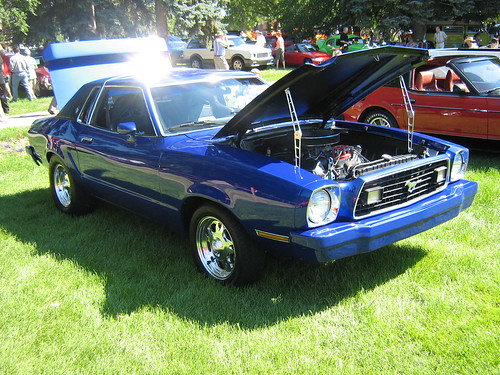
My 1974 Ford Mustang II Ghia

Just prior to leaving school at Mare Island a class mate put his Mustang up for sale. On impulse, I decided to purchase the little sport car. It was a 1974 Ford Mustang II Ghia with a standard transmission and a V6 engine. And blue.

No, not my car, way to nice, but same color/body

To be clear, at the time I did not know anything about cars and couldn't tell you the difference between a Mustang or a Camaro, and the only difference between a V6 and V8 was only that the later sounded bigger. I certainly didn't know the difference between the legendary Mustang and the newer Mustang II.

It turned out that this was not some high performance muscle car. It was Fords answer to high gas pricess in the 70's. It was "economical", the hated word of all car-buffs, and built out of Ford Pinto parts.

But it looked cool, impressed the girls, and that counts for quite a bit to a young guy. In retrospect, it WAS a pretty good car. The V6 engine was peppy and handling better than one would expect (the front end would later be used in many custom car builds).

I have a lot of stories in this car. Learning to drive a stick in the hills of San Francisco. Driving cross country and 70 mph backwards off of the interstate in a Nebraska ice storm. Making the turn when common sense would say to go around and try again. Nearly killing my family on a trip to the airport ... and making the recovery look planned. The cheating girl friend who asked for custody of the car during the break up. Fun times.

Ultimately, the car was a victim of the Navy life style - extended storage periods, salt, and lack of routine mainenance. I traded it in for a pickup truck. A trade I almost immediately regretted - but life is like that some times. Now I recall the "little Mustang" as one of my favorite cars.

Friday, June 15, 1984

Data Systems Class "A" School


I attended Data Systems Class "A" School at Mare Island (Vallejo) California, class of December 1983. That's me, second row, second from the left. Petty Officer 3rd Class LaFleur.

Data Systems was the U.S. Navy's computer engineering program for Petty Officers. DS "A" school was 6 months of very intense training on everything a budding computer technician would need to know (and yes, today everyone is called an Engineer, but in the Navy an engineer is the guy who works on the ships propulsion system). Unlike civilian college, there was no history or English to muck up the day, just 8 hours every day learning computer theory. Some of the fun topics included:


  • Multi-base number systems, from back before a byte was standarized on 8 bits we had to learn base 2, 7, 8, and 16. Funny story about getting a nieces math question wrong because 4+6 can be 10, 12, 13, or even "A". 
  • Programming in machine language - and I mean REAL machine as in each system had it's own bit setting system and not of this fancy compiler languages that modern computers use. We did the registry by registry Boolean logic, shifts, counters, jump and indirect jump syntax ...  it was pretty amazing to find out that a computer really were incredibly simple as adding two numbers together or copying a number from one location in a register to another. And still is.Years later, the C programming language would seem down right verbose!
  • Working through hundreds of pages and pages of schematics comprised AND, OR, NAND, and NOT gates. I can't even begin to describe the mental construct you'd have to build to resolve problems like "if pin 7 on AND gate 219 on figure 128 shorted to ground, the symptom would be ... .
  • Timed troubleshooting tests; rushing into the "comtran-10" lab and and having sixty minutes to take voltage readings (pin j102 hot, pin i99 ground. ...) to walk through the prints and figure out what fault had been inserted into the system. I was "an ace" at fixing that trainer ... to bad it only existed in school.
  • And on top of the technical training, there was the never ending military BS, crazy hours, endless inspections, keeping you under constant pressure to see if you could handle it. I'd heard that full training (boot camp, Basic Electricity and Electronics, DS "A" school, and DS "C" school) costed nearly a million dollars per recruit and they were going to ensure they got their money worth.
I think we we were the last generation of computer technicians that were given the deep dive into theory. I know later, when PC were popular and line replaceable units the norm, the technicians coming out of school didn't seem to have the same ability to troubleshoot problems that we were expected to. Or maybe that's just me being the old guy bragging about how tuff it was back in the day.